Smash App UX Overhaul: Powering the Future of Local Badminton

A seamless, all-in-one platform that transforms how players book courts, find partners, manage coaching, and host matches — designed to boost engagement and drive growth with every tap.

Role

UX/UI Designer. Branding Desginer

Platform

Mobile App, Website

Duration

2 months
a cellphone leaning against a wall

Background

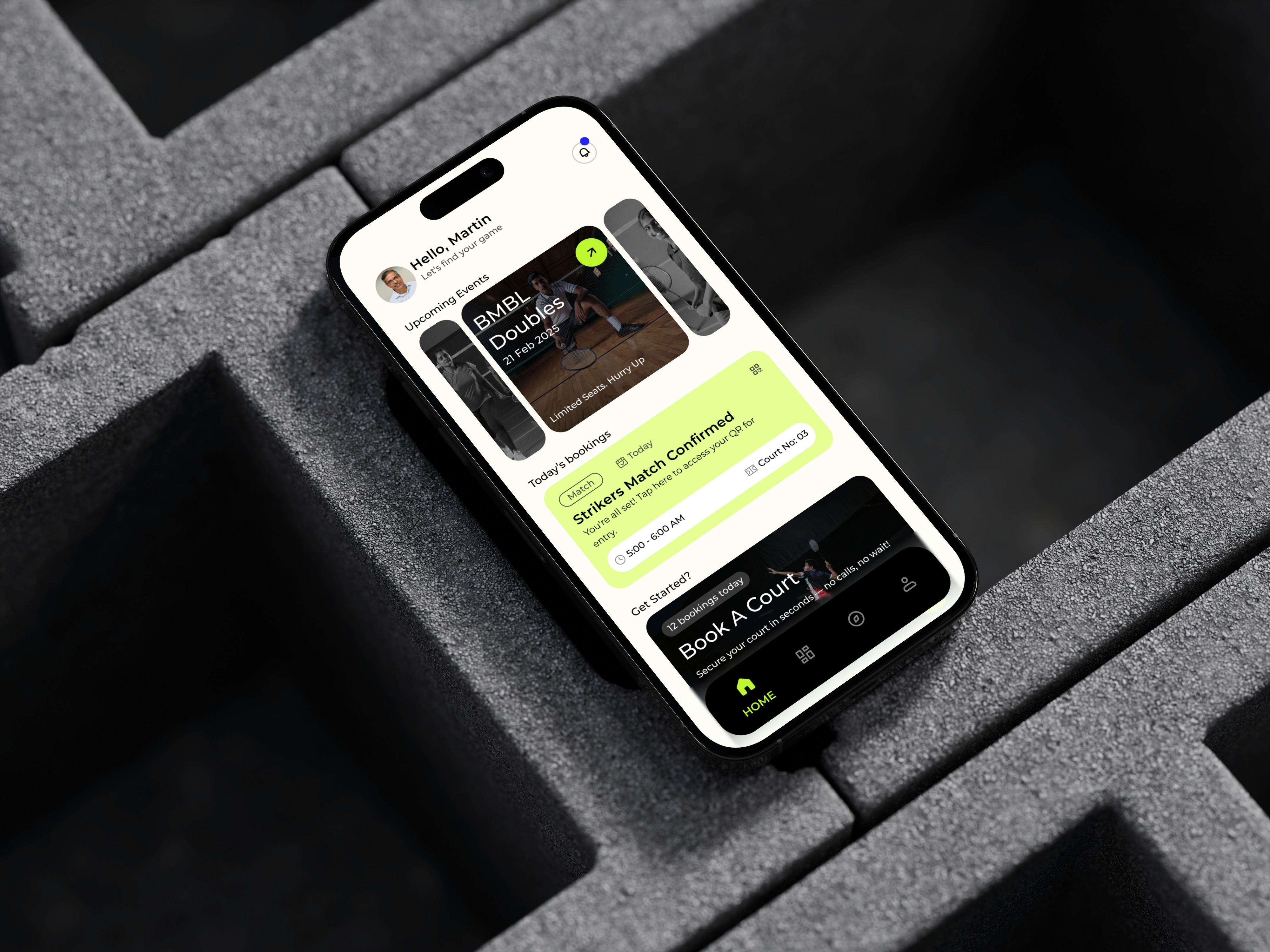
The client initially approached me to modernize their logo and design posters. But through early conversations, we uncovered a bigger opportunity: a custom app and website to support their growing community.

As the sole UX designer, I transformed this vision into a full platform that connects players, tracks progress, and celebrates every match as part of a shared journey.

Challenges


  • Fragmented Booking Experience

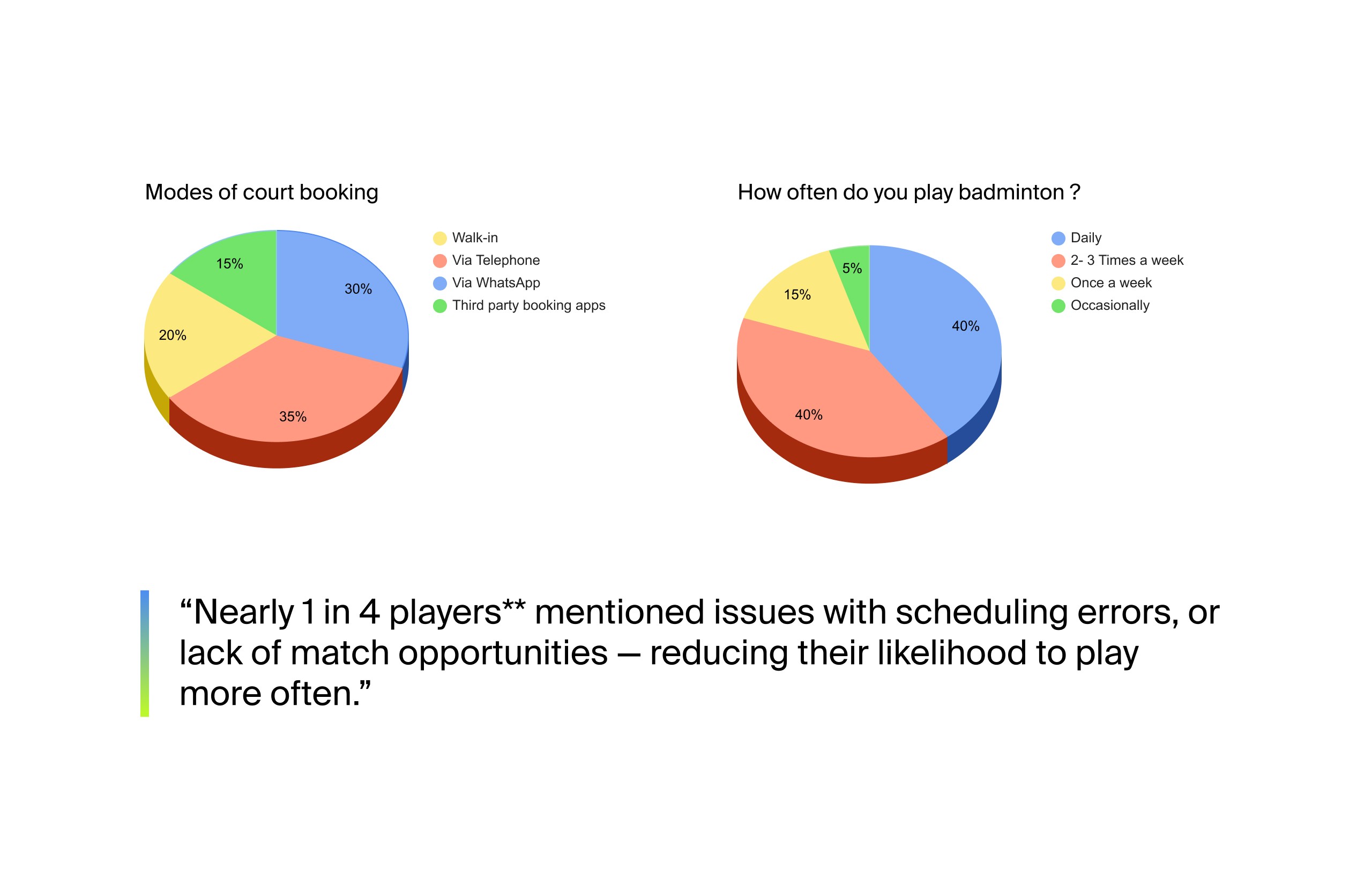
    Players relied on calls, messages, or walk-ins — leading to scheduling issues, double bookings, and no-shows.


  • Limited Player Engagement

    Finding partners was manual and inconsistent, reducing play frequency and engagement.


  • Manual Coaching Management

    No clear session info or coach availability, leading to missed or overbooked slots


  • Low Digital Engagement & Revenue Opportunities

    No digital touchpoints meant lost retention, fewer bookings, and weak community monetization.

Solution


  • Real-Time Court Booking

    Players can instantly reserve courts with live availability, reducing friction and cut manual coordination.


  • Partner Matchmaking

    Discoverability of suitable partners based on preferences and availability.


  • Seamless Coaching Management

    View detailed coach profiles, book sessions in-app, and receive timely reminders — improving turnout and trust.


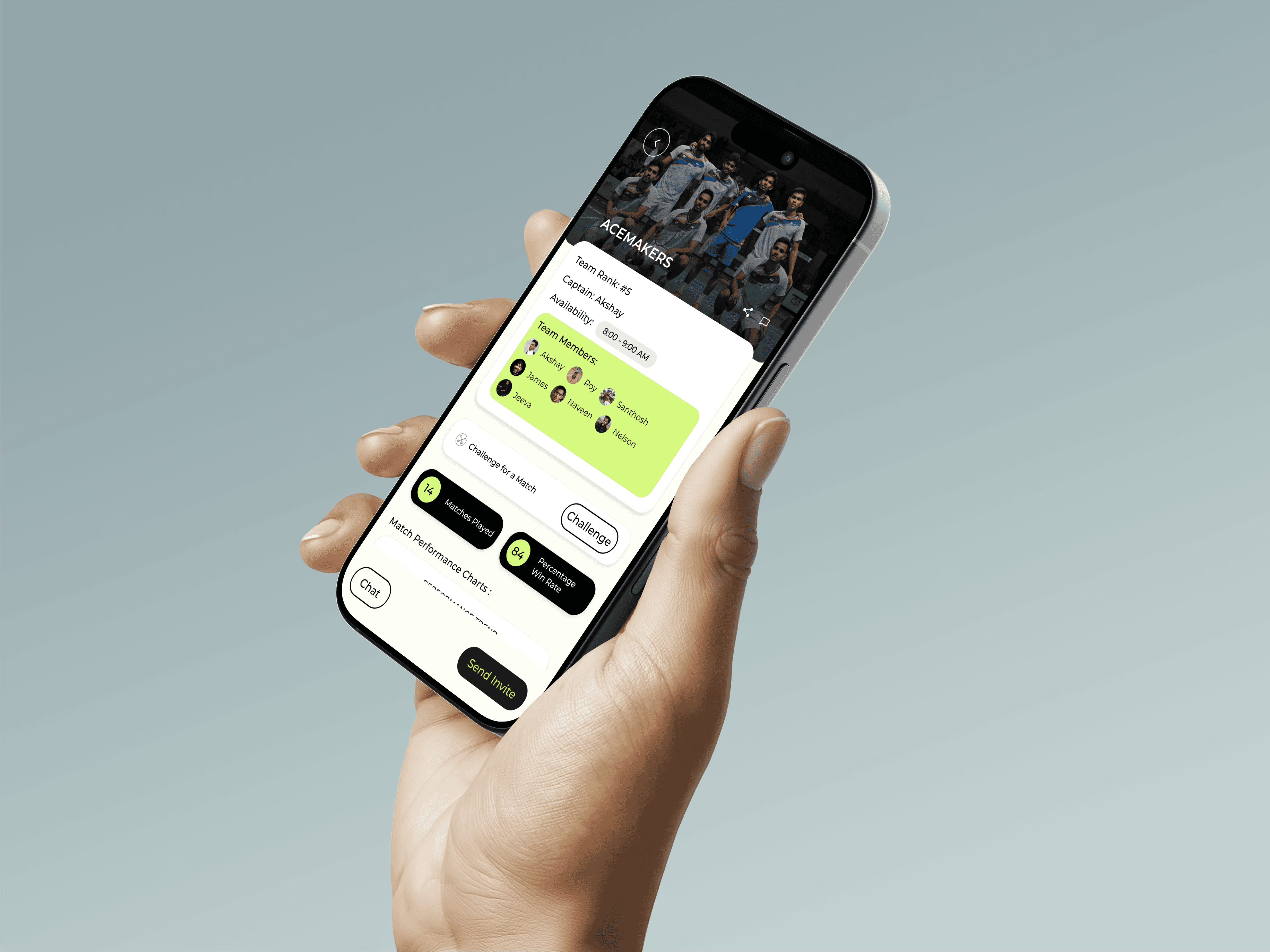
  • Host Matches & Track Progress

    Users can create or host matches, log scores, and view performance stats over time — transforming casual games into motivating progress journeys.


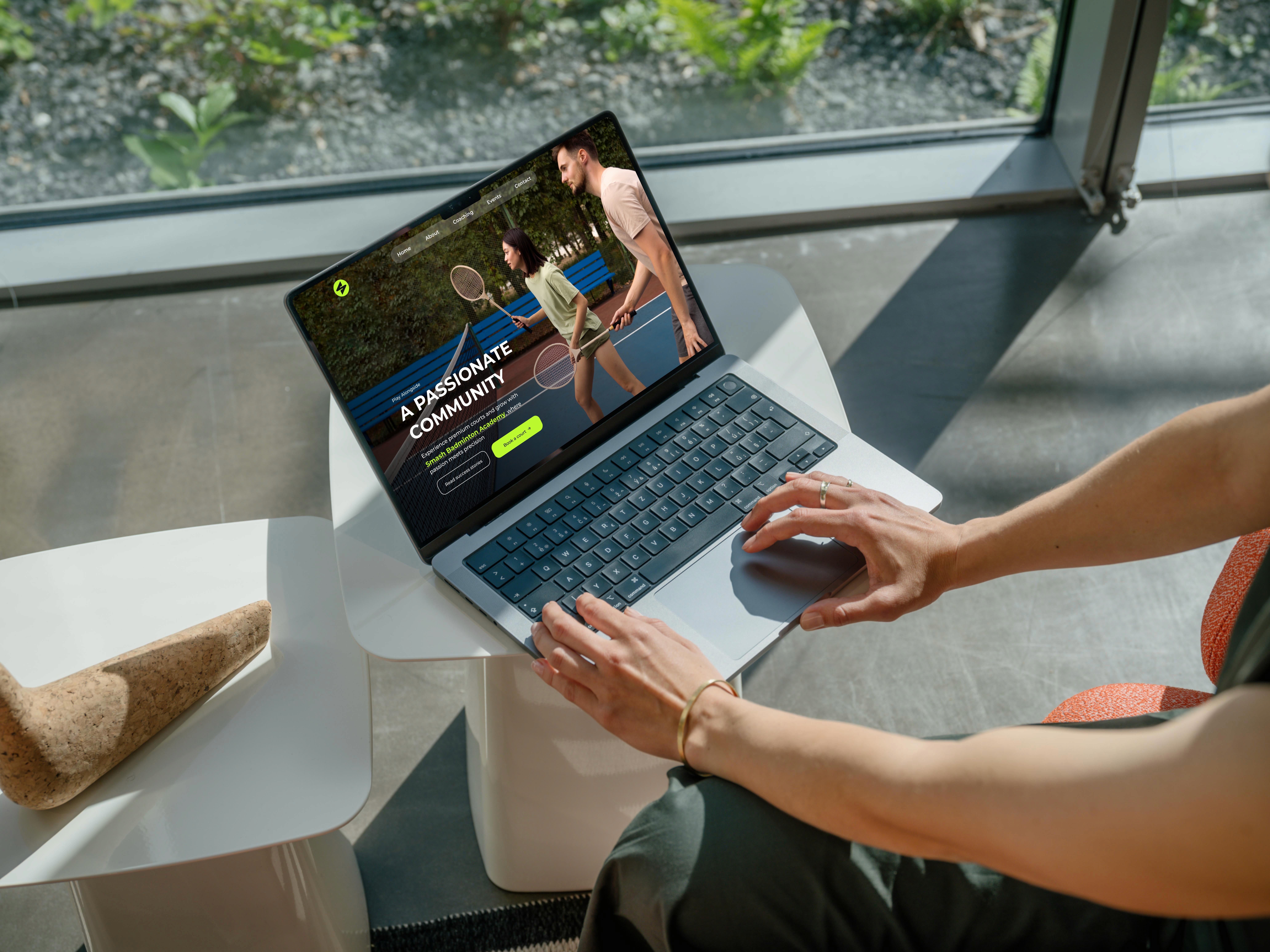
  • Strong Digital Presence & Monetization Tools

    Website + app drive community engagement and unlock new revenue streams.
a cell phone on a ledge

Phase 1. Research and Discovery

Objectives

  • Identify pain points in booking local courts, organizing matches, and finding coaching/partners.

  • Understand diverse user needs: adults, parents, casual players, competitive athletes.


Methodology & Findings

  • Through competitive benchmarking with community apps like Playo, Khelkaro and Playfinder, I identified a clear gap: most apps focus only on transactional booking, overlooking the growing demand for a community-driven experience.

  • Conducted 6 in depth user interviews with casual players, parents of junior players, and competitive players. These sessions revealed recurring issues — like hidden court availability, lack of structured coaching visibility, and friction in partner matchmaking.

  • I synthesized findings through user journey maps, and SWOT analysis. This helped shape a core insight: Smash shouldn't just be a booking app — it should be a platform that builds community, supports skill development, and simplifies match play.

Phase 1. Research and Discovery

Objectives

  • Identify pain points in booking local courts, organizing matches, and finding coaching/partners.

  • Understand diverse user needs: adults, parents, casual players, competitive athletes.


Methodology & Findings

  • Through competitive benchmarking with community apps like Playo, Khelkaro and Playfinder, I identified a clear gap: most apps focus only on transactional booking, overlooking the growing demand for a community-driven experience.

  • Conducted 6 in depth user interviews with casual players, parents of junior players, and competitive players. These sessions revealed recurring issues — like hidden court availability, lack of structured coaching visibility, and friction in partner matchmaking.

  • I synthesized findings through user journey maps, and SWOT analysis. This helped shape a core insight: Smash shouldn't just be a booking app — it should be a platform that builds community, supports skill development, and simplifies match play.

Phase 2. Concept development and User Journey Map

  • With research insights in place, I defined the app's core pillars: Booking, Partner Matching,Coaching, Hosting Matches and Track Progress. Developed user personas and mapped user flows to guide the design process.

Phase 3. UI design and prototyping

  • Designed high-fidelity prototypes in Figma, focusing on clean layouts, sporty visuals, and frictionless flows. The one-page booking screen, guided coaching browser, and match dashboard were built to support real-time decisions and keep users in flow.

  • Used a bold yet approachable color palette to reflect energy and community. Iterated based on internal feedback to ensure clarity, scalability, and mobile responsiveness across all touchpoints.

Phase 2. Concept development and User Journey Map

  • With research insights in place, I defined the app's core pillars: Booking, Partner Matching,Coaching, Hosting Matches and Track Progress. Developed user personas and mapped user flows to guide the design process.

Phase 3. UI design and prototyping

  • Designed high-fidelity prototypes in Figma, focusing on clean layouts, sporty visuals, and frictionless flows. The one-page booking screen, guided coaching browser, and match dashboard were built to support real-time decisions and keep users in flow.

  • Used a bold yet approachable color palette to reflect energy and community. Iterated based on internal feedback to ensure clarity, scalability, and mobile responsiveness across all touchpoints.

a cell phone on a table

Solution 01: One-Page Smart Booking Flow


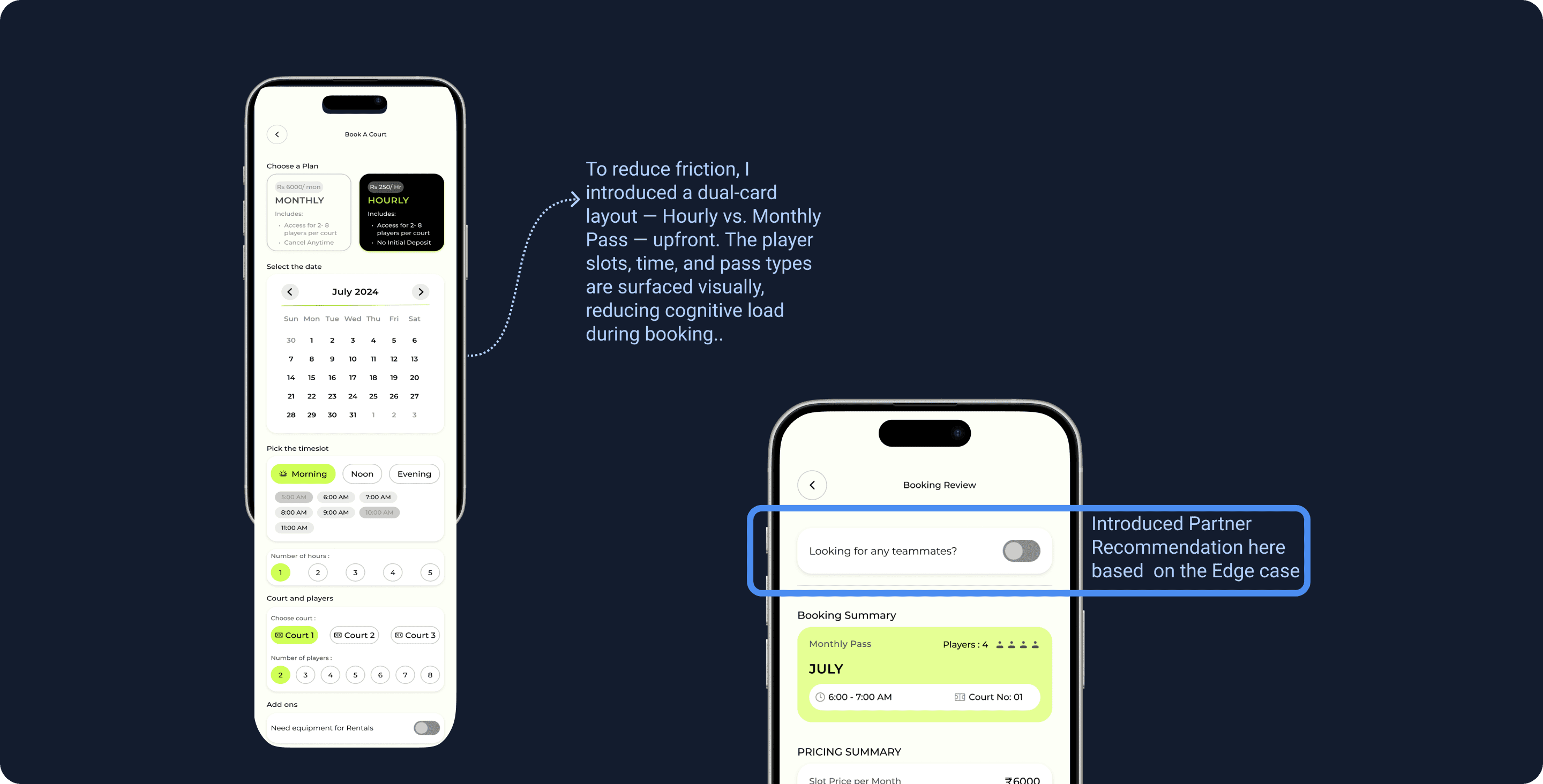
To eliminate decision fatigue and reduce booking time, I designed a single-page booking experience that brings all essential information into one view. Players can see real-time availability across three courts, select time slots from 5 AM to 10:30 PM, choose duration, player count, and instantly compare Hourly vs. Monthly passes.

A key design decision was to surface pricing, pass type, and slot availability upfront — enabling quick, confident decisions with zero guesswork. This streamlined flow minimizes back-and-forth interactions, significantly improving conversion during busy hours.

EDGE CASE : Partner Discovery Without Flow Break

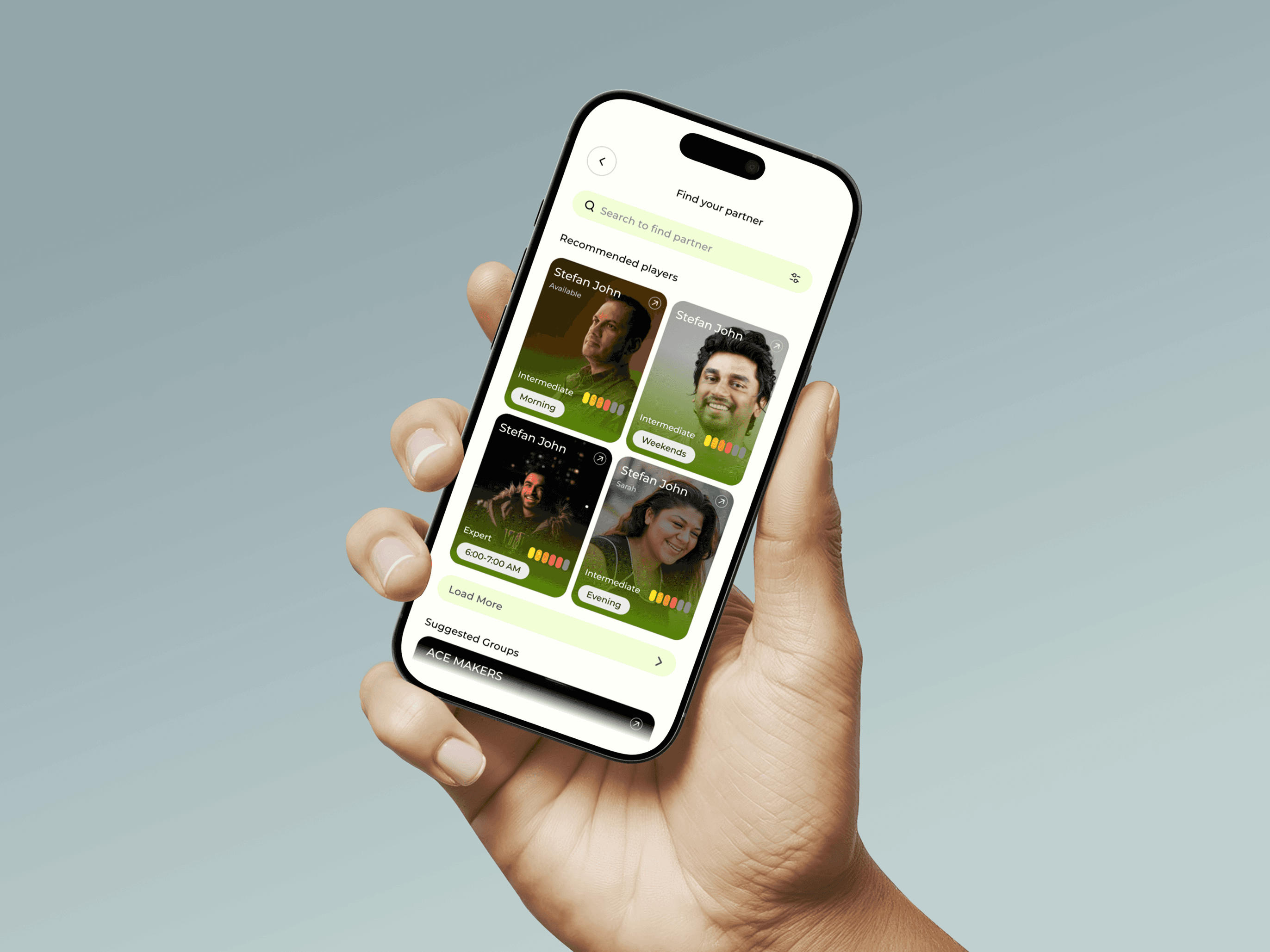
During testing, we uncovered a frequent blocker: many users didn’t have a full team when booking. To solve this, I added an optional prompt — “Need a Partner?” — just before payment. This let users:

  • View recommended players based on skill

  • Check profiles, send invites

  • Return to payment — without starting over

    It’s an add-on, not a detour, keeping users in flow while solving a real need.
a cellphone leaning against a wall

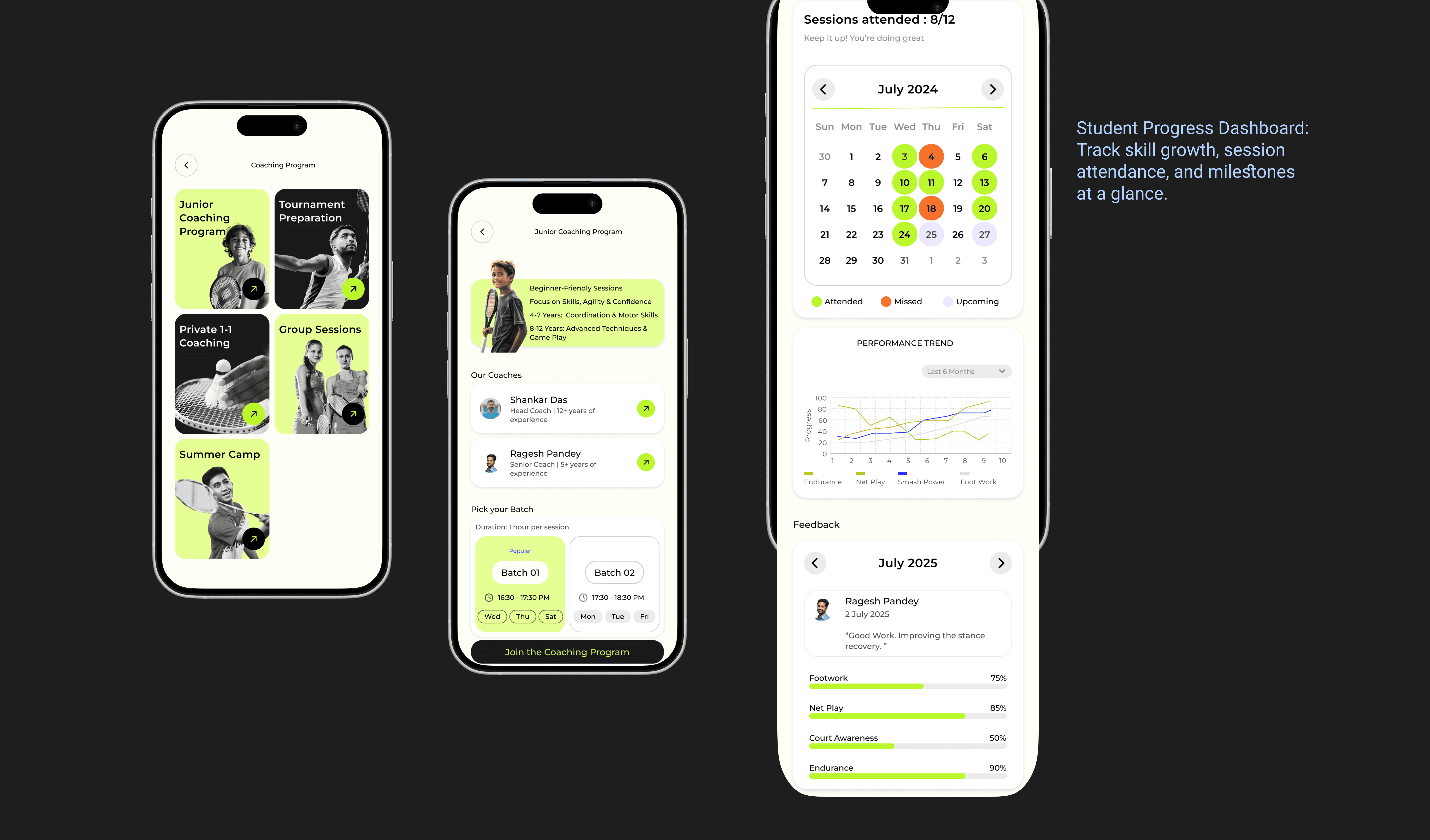
Solution 02: Structured & Trust Driven Coaching

I designed a guided coaching discovery experience focused on structured visibility, trust-building, and smoother decision-making for parents. Users can now explore all available coaching sessions filtered by age group, skill level, and timing — with transparent schedules.

Coach Discovery That Builds Trust, Not Doubt

During research, parents expressed hesitation in booking due to limited information about coaching quality and availability. To solve this, I introduced detailed Coach Profiles as part of the flow:

  • Display coach bios with photos, experience level

  • Show real-time session availability and parent ratings/reviews

  • Highlight "Trusted by 50+ parents" badges to build confidence
a cell phone on a rock

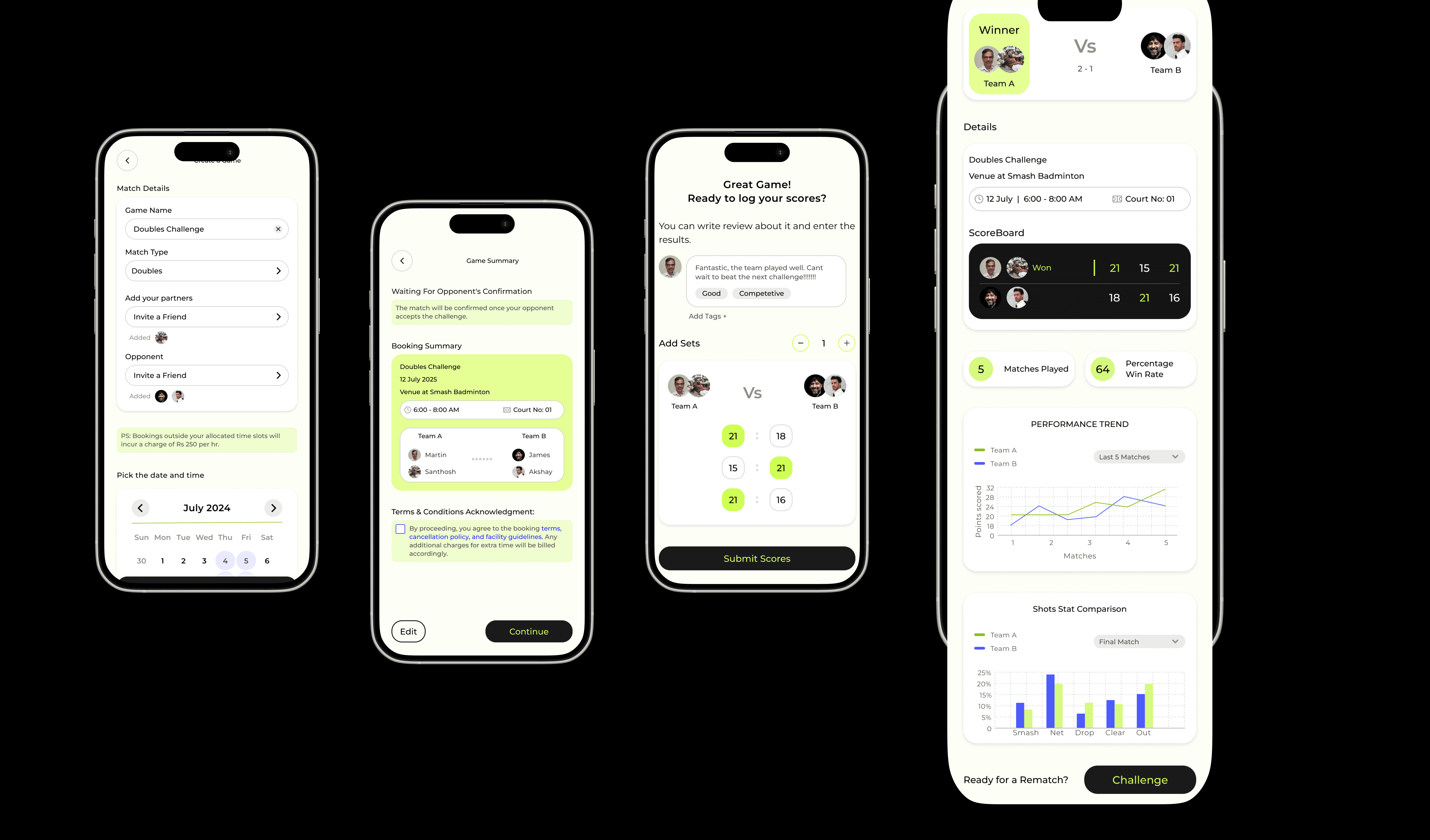
Solution 03: Match Hosting That Fuels Repeat Play

To reduce coordination hassle and drive long-term engagement, I designed an end-to-end Match Creation and post-match tracking flow — eliminating the need for external messaging apps and manual scorekeeping.

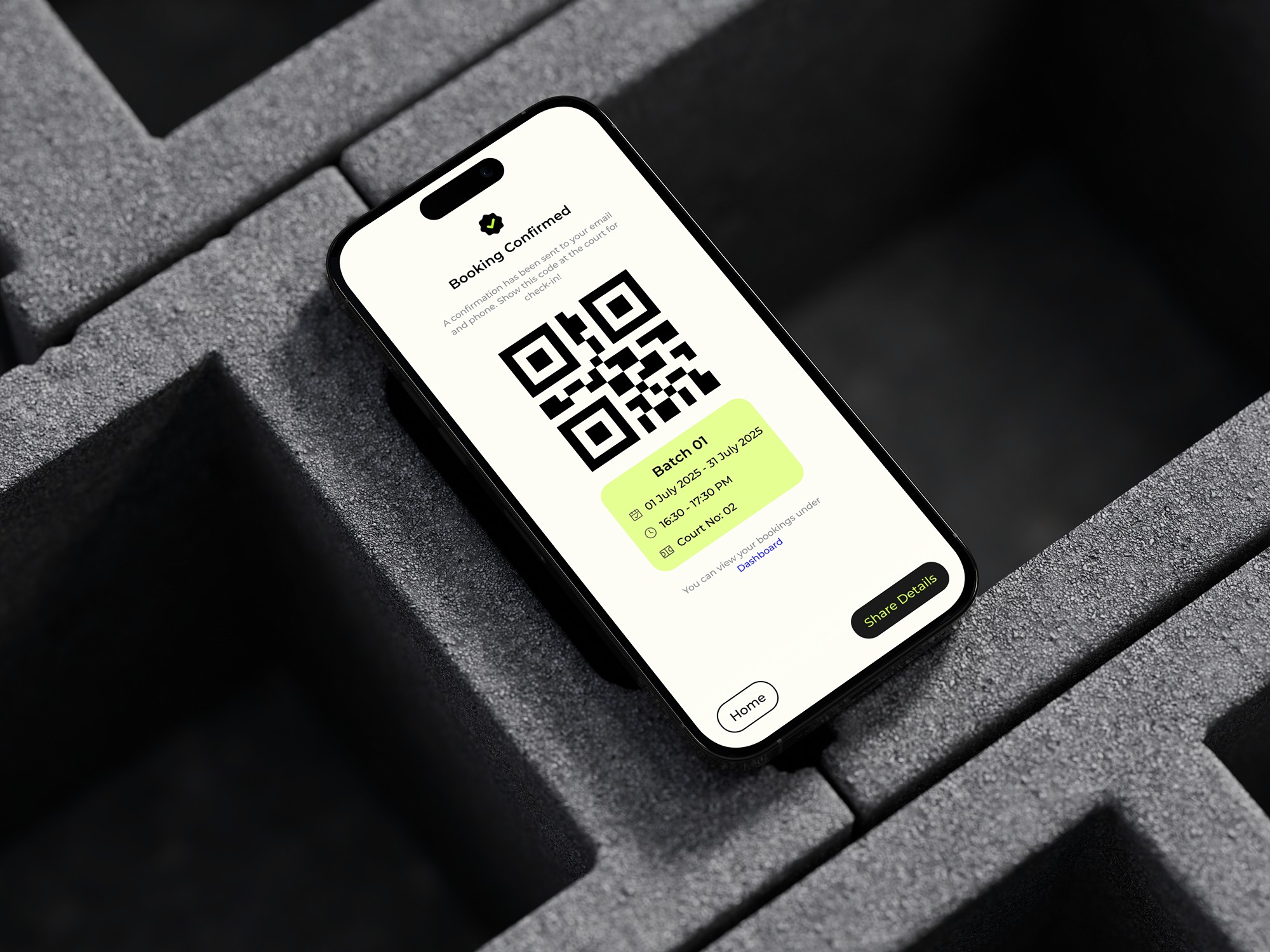
Players can now create a match in seconds, invite teammates, confirm details, and share match info instantly via WhatsApp or SMS.

Key UX Decision: Drive Post-Game Engagement

I introduced a post-match prompt that nudges players to log scores, rate matches, and view updated stats — transforming casual play into a progress-driven experience.

This closed-loop flow reduces friction, boosts repeat participation, and creates a habit loop of play → score → improve.
Phase 4. Early testing and iteration

  • Conducted usability walkthroughs with prototypes — players valued the smooth booking flow and post-match stats; parents appreciated the structured coaching discovery..

  • Feedback confirmed strong potential; awaiting client greenlight to move into development and refine based on real-world behavior.
a cell phone on a bench

Impact

  • Reduced Booking Friction: Prototype testing showed a 60% faster booking completion time with the one-page flow — a promising sign for conversion.

  • Improved Match Engagement: 70% of users said they would use the score logging feature to track personal progress post-game — indicating higher retention potential.

Reflections

  • Designing Beyond Utility: This project reinforced that users don’t just want to book — they want to connect, improve, and feel part of a community.

  • Trust Needs Transparency: Interviews with parents and players revealed that clear information and visual cues directly influence confidence and repeat use.

Impact

  • Reduced Booking Friction: Prototype testing showed a 60% faster booking completion time with the one-page flow — a promising sign for conversion.

  • Improved Match Engagement: 70% of users said they would use the score logging feature to track personal progress post-game — indicating higher retention potential.

Reflections

  • Designing Beyond Utility: This project reinforced that users don’t just want to book — they want to connect, improve, and feel part of a community.

  • Trust Needs Transparency: Interviews with parents and players revealed that clear information and visual cues directly influence confidence and repeat use.

Other projects

Copyright 2025 by Abeena Lijo

Copyright 2025 by Abeena Lijo

Copyright 2025 by Abeena Lijo

Create a free website with Framer, the website builder loved by startups, designers and agencies.